
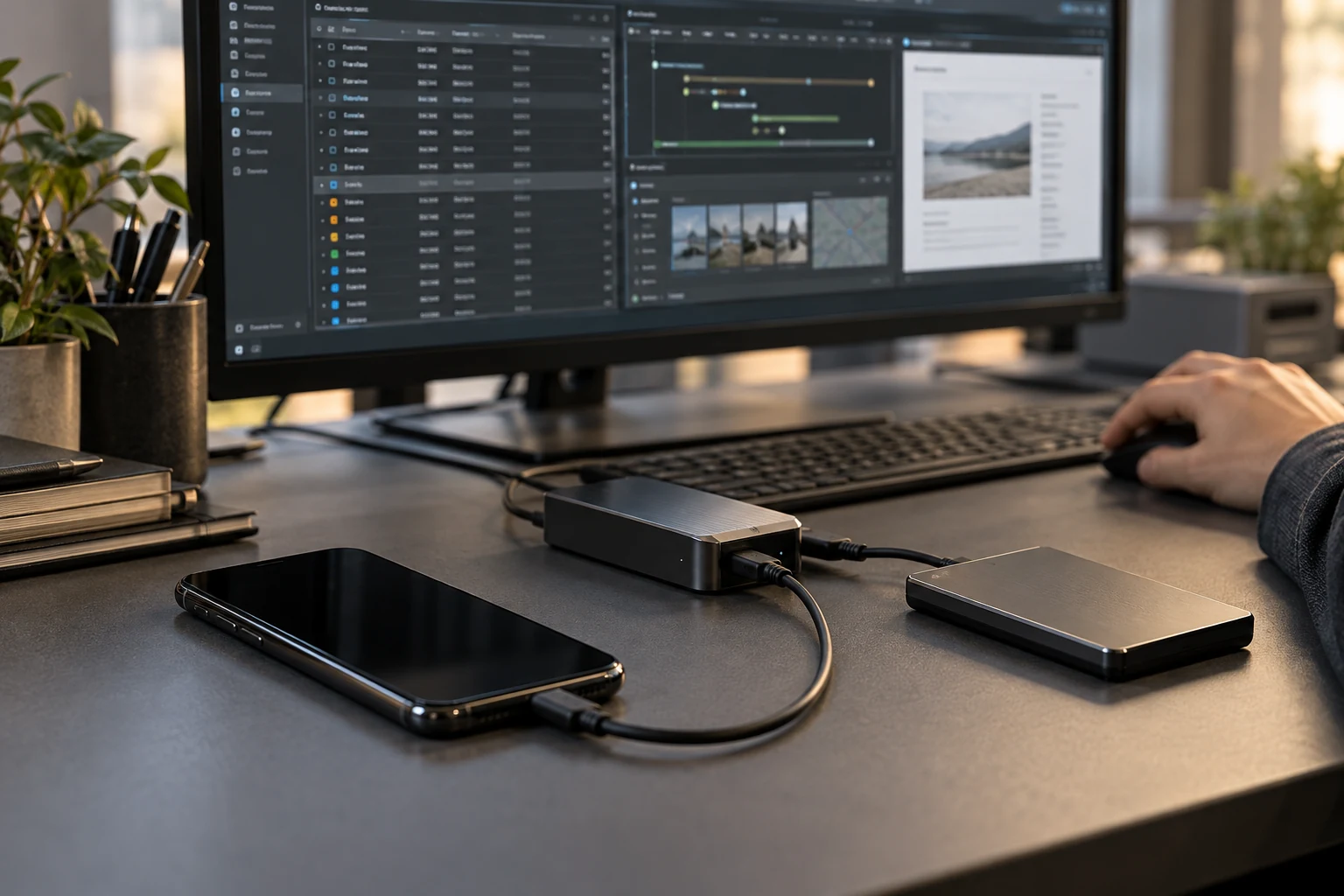
Understand what happened
An unusual connection, missing files or a chronology to clarify: digital investigation searches for traces in devices and systems. Information is compared to establish what can be confirmed.
Detailed log audits and forensic analysis of computers and phones have been carried out for law firms. Sources, findings and recovery limitations are documented.
Find the elements of a chronology
Example need.Read moreShow less
Example need. A law firm needs to understand when a file was accessed or modified. Within the authorised scope, copies of media, system and firewall logs, metadata and available backups are compared.
Forensic acquisition, log analysis and deleted-data recovery tools examine retained traces. Clock differences and periods without data are reported. The report separates established elements, hypotheses and matters that cannot be concluded. A network address or location trace alone does not identify a person.
Firewalls and connection logs
Firewall logs can be analysed alongside those of endpoints, servers and applications.Read moreShow less
Firewall logs can be analysed alongside those of endpoints, servers and applications. Allowed or blocked connections, network addresses, times and security events are compared according to the information retained.
The aim is to understand observed exchanges and their sequence. Clock differences, missing periods and log limitations are taken into account.
Computers, phones and storage media
Accessible files, messages, histories and usage traces are examined.Read moreShow less
Accessible files, messages, histories and usage traces are examined. Several sources can be compared to check an event or recover information in context.
Deleted data
Deleted data can be searched for on media and in available copies or backups.Read moreShow less
Deleted data can be searched for on media and in available copies or backups. Recovery possibilities depend particularly on the medium, its condition, encryption and subsequent overwriting.
Recovered items are distinguished from incomplete fragments and information that could not be found.
Location and chronology
Location data in accessible files, photographs, applications or histories can be examined.Read moreShow less
Location data in accessible files, photographs, applications or histories can be examined. Its origin, date and precision are checked before comparison with other events.
A location clue must be interpreted in context. It does not, on its own, establish a person’s presence at a location.
A report that explains findings
Observed facts, hypotheses and unresolved questions are separated.Read moreShow less
Observed facts, hypotheses and unresolved questions are separated. Sources and analytical limitations are described so that conclusions can be understood and checked.
An intervention defined for the case
The research objective, authorisations, available devices and confidentiality conditions are established before intervention.Read moreShow less
The research objective, authorisations, available devices and confidentiality conditions are established before intervention. Source preservation is considered from the preparation stage.